
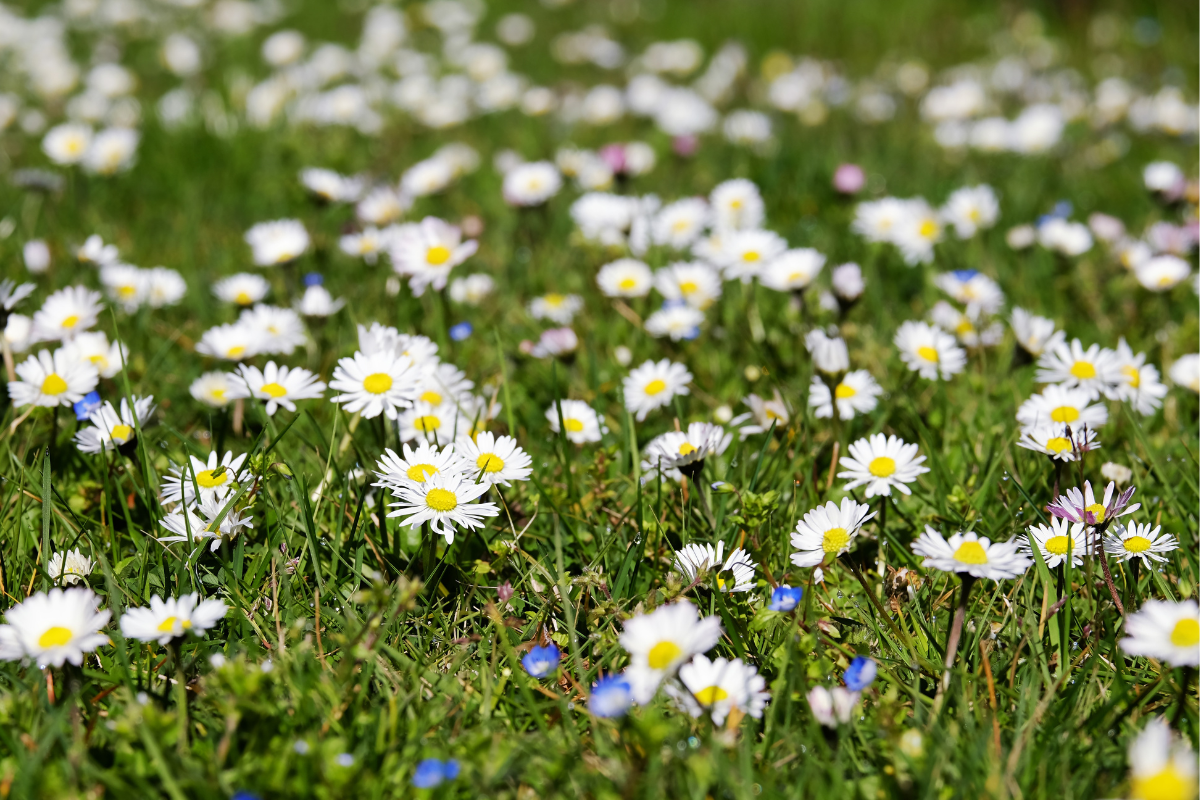
When we stroll through meadows and fields or enjoy nature in our own garden, we often encounter a fascinating variety of flowers and plants. One family stands out in particular: the daisy family, also known as "Asteraceae". This multifaceted group of plants not only delights us with its colorful splendor but also plays a crucial role in the preservation of our ecosystem. But that's not all: it also shapes our history with a special cultural significance.
In this post, we will dive together into the colorful world of the daisy family.
Contents:
Botanical characteristics of the daisy family Distribution of the daisy family The discovery history of the daisy family Cultural significance of the daisy family Ecological significance of the daisy family Preservation and protection of biodiversity Our favorite among the daisy family: Artemisia annua Conclusion
Botanical characteristics of the daisy family
Let's start with a look at the botanical characteristics of the daisy family - that plant family whose charm and diversity have always captivated people. For although this family comprises around 24,000 species, daisies do have some characteristics in common. Their flowers are typically "basket-shaped" arranged, with many small flowers forming a large inflorescence - as we can observe in tansy or yarrow. However, there are also daisies that consist of a single flower, as is the case with the sunflower.
Their leaves are usually alternately arranged and can be completely different in shape and size. The fruits are often achenes, which are small, single-seeded fruits surrounded by a calyx. These fruits are often equipped with a pappus, a kind of parachute that helps them spread by wind.
Well-known representatives of the daisy family include the marigold (Calendula), the daisy, chamomile, goldenrod, thistle, and dandelion.
Distribution of the daisy family
The daisy family is characterized not only by its diversity but also by its extraordinary adaptability. They are distributed all over the world and occur in almost all climate zones - from tropical rainforests to arctic tundras, we find them everywhere. Some species have even adapted to extreme locations such as salt marshes or alkaline soils and are able to survive under the most adverse conditions.
Nevertheless, there are areas where we find particularly many daisies. These include:
-
Temperate climate zones: Especially in Europe, North America, and parts of Asia, daisies are particularly widespread. Here they thrive both in the wild and in cultivated landscapes.
- Mediterranean regions: In the sun-drenched landscape around the Mediterranean, many daisies also thrive and shape the landscape of flora and fauna.
- Prairies and steppes: In the vast prairies of North America and the steppes of Eurasia, daisies often dominate the vegetation. They are adapted to dry conditions and play an important role in these ecosystems.

The discovery history of the daisy family
The history of the daisy family goes back a long way and is closely linked to the development of botany and natural sciences. For already in antiquity, people began to study and analyze plants. Early Greek philosophers, including Aristotle, described characteristics and types of plants such as the daisy family. Later in the Middle Ages, many plants were documented in herbals, in which their characteristics and uses were recorded.
During the Renaissance and early modern period, botany experienced a significant boom. Scientists such as Carl von Linné began to develop systematic classification systems for plants. This made it possible to assign the daisy family their scientific name and to classify them into various groups.
In the 18th and 19th centuries, many scientists undertook research expeditions, during which they discovered and documented numerous new daisy species. In the course of the 20th century, significant scientific successes were achieved. This made it possible for researchers to examine and understand the structure, function, and evolution of the daisy family more precisely.
Today, researchers use modern technologies and methods to analyze the genetics, ecology, and biology of the daisy family in more detail. Continuous advances in biotechnology enable researchers to continuously discover new applications for this special plant family.
Cultural significance of the daisy family
The history of the daisy family is accompanied by a strong cultural imprint. For ever since they accompanied us humans on our way, we have assigned special meanings to them. For example, they have symbolic meaning in many cultures and are often associated with certain characteristics or ideas. A clear example of this is the sunflower, which in ancient Greece was assigned to the sun god Helios and symbolically stood for light, strength, and fertility. In other cultures too, various daisies were associated with positive characteristics and were part of traditional customs, ceremonies, and festivals.
In addition, many artists and writers were inspired by the beauty and diversity of the daisy family. Their bright colors and extraordinary shapes made them an ideal motif for works of art, pictures, poems, and stories. For example, William Wordsworth's poem "Daisy". Here the poet writes about the beauty and simplicity of the daisy and reflects on the transience of life.
Ecological significance of the daisy family
But the daisy family has not only played an important role for us humans since time immemorial - they are also indispensable for the prevailing ecosystem. There are various reasons for this:
-
Pollination: To reproduce, many daisies rely on pollinating insects such as butterflies, bees, and beetles. They attract insects with their strikingly colored and pleasantly scented flowers and offer them food in the form of nectar and pollen. Through this interplay, they contribute to the survival of many insects and play a crucial role in various ecosystems.
- Food source: Daisies are an important food source for pollinators and other animals alike. While insects mainly feed on their nectar and pollen, seeds and larger plant parts are eaten by birds and other small animals.
-
Soil improvement: Some daisies, such as yarrow, have very deep roots. This loosens the soil and thus improves the soil structure. This promotes the fertility and quality of the soil and at the same time supports the growth of other plants in their environment.
-
Habitat: Many daisies provide a natural habitat for insects and other invertebrates such as snails, spiders, or woodlice.
-
Natural pest control: Some daisies produce natural pesticides to protect themselves from pests. This can help maintain ecological balance in agricultural systems.
Preservation and protection of biodiversity
The daisy family undoubtedly plays an important role for our prevailing ecosystem. Unfortunately, many of them are already threatened with extinction and are under special protection - for example, arnica in the Alpine region of Europe.
But what can we actively do to help protect the daisy family? Here are some ideas on how you can contribute to the protection of this valuable plant family:
-
Preserve natural habitats: We can all work to preserve natural habitats. This process ranges from private forest walks, where we deliberately make sure to leave as few traces as possible, to membership in nature conservation organizations or participation in local political projects.
-
Design your garden close to nature: When designing your garden, terrace, or balcony, pay attention to a natural alignment. This means: Plant more native daisies or other insect favorites such as wildflowers, perennials, and grasses. It is also beneficial if you do not meticulously control every inch of your garden. You do our ecosystem the greatest favor if you - if possible - leave the garden care to nature.
-
Share your knowledge: Education is an important step towards a nature-friendly, environmentally conscious future. Therefore: Pass on your knowledge whenever the opportunity arises. Inspire your friends and acquaintances for small wildflower meadow projects and send your children to excursions of your local nature conservation association. Only in this way can we jointly contribute to a tomorrow in which humans and nature live in peaceful symbiosis.
Our favorite among the daisy family: Artemisia annua
Among the daisy family, there is one plant that we at Tesana are particularly fond of: Artemisia annua, also known as sweet wormwood.
This fascinating plant originally comes from Asia, where it has been cultivated by people for centuries. It exhibits a wide range of nourishing applications, including cosmetics and aromatherapy.
We are enthusiastic about the great potential of this unique plant - and we would love to share this enthusiasm with you. That's why we cordially invite you to discover this powerful plant in our range!
Conclusion
→ Without a doubt, composites are an impressive plant family that has always fascinated us humans.
→ From their striking flowers and intoxicating scents to their symbolism and cultural significance, composites have fascinated and inspired humanity for centuries.
Nevertheless: Many of them are now threatened with extinction and need our help! Their preservation is crucial so that your great-grandchildren can also enjoy the amazing diversity as we do today. Help protect this important plant family for future generations - so that they continue to enrich us with their beauty.


